mercoledì 3 febbraio 2016
Biblioteche: Società Geografica Italiana
Sul colle Celio, in mezzo alle rovine della Roma protocristiana, si trova palazzetto Mattei, villa circondata da un parco con piante esotiche, sculture, obelischi. Bella atmosfera che fa pensare ad avventure ed esplorazioni, soprattutto perché il palazzo ospita la Società Geografica Italiana. Occorre fare una tessera gratuita, poi vi accompagneranno nella bellissima sala della biblioteca, con antichi scaffali contenenti libri ancora più antichi. Al centro della sala, un mappamondo (piccolo, un po' deludente) e delle cartografie raccolte in quelle impaginazioni enormi. Studierete alla luce di una finestrona aperta sul parco. E' sempre vuota, ma il problema più grosso è l'orario: aperta 5 giorni su 7, di cui 3 soltanto alla mattina. Ci sono delle mostre fotografiche in corso. Il personale è molto gentile.
Esterno: 9
Interno: 9
Possibilità di concentrazione: 8
Orario: 4
martedì 2 febbraio 2016
Biblioteche: Biblioteca Romana Sarti
Nella sede dell'accademia di San Luca, in un palazzo alla cui costruzione partecipò Borromini, si trova questa biblioteca ormai non più sconosciuta. Aperta anche il sabato, vi conviene arrivare presto per trovare un posto. Occorre fare una tessera gratuita. La sala è bella, all'ultimo piano del palazzo; di estate però le finestre vengono tenute aperte e i turisti che passano nella strada adiacente (a 20 metri c'è la fontana di Trevi) fanno un po' di rumore. La biblioteca contiene testi d'arte e di architettura che potete consultare liberamente. Nelle pause pasto, si consiglia di prendere un panino, andare alla vicina chiesa di Sant'Andrea delle Fratte ed entrare nel cortile a mangiare; qui potrete sentire gli allievi del conservatorio di Santa Cecilia suonare.
Esterno: 8
Interno: 6,5
Possibilità di concentrazione: 6
Orario: 10
lunedì 1 febbraio 2016
Prix de la « recherche patiente » - Fondation Le Corbusier
Conformément aux souhaits de son créateur, la Fondation Le Corbusier souhaite encourager la recherche en attribuant chaque année un prix destiné à récompenser un(e) chercheur ayant choisi de dédier son travail à l'œuvre de Le Corbusier.
Depuis l’année 2015, la Fondation a décidé de consacrer cette politique à des travaux déjà réalisés, publiés ou non. Le soutien de la Fondation viendra consacrer une recherche dans laquelle la présence de Le Corbusier et/ou de son œuvre tient une place significative voire prépondérante.
Il est souhaité que les travaux soumis à l'examen du jury concernent des aspects de la vie et/ou de l’œuvre de Le Corbusier qui n’auraient pas fait jusqu’à présent l’objet de recherches approfondies, ou qui proposeraient, pour des thématiques déjà traitées, des approches originales (analyses comparatives, pluridisciplinaires, transversales, etc.). Tous les aspects de l’œuvre de Le Corbusier et de sa réception peuvent être concernés : l’œuvre construit, les projets d’architecture ou d’urbanisme non réalisés, le mobilier, l’œuvre plastique – peinture, dessin, tapisserie, gravure, expositions, etc. –, l'œuvre littéraire et théorique ; toutes propositions contribuant à la connaissance de l’homme et à la compréhension de son héritage.
Cet appel à candidatures s’adresse à de jeunes chercheurs (maximum 40 ans).
Les candidats pourront éventuellement justifier l’utilisation du prix attribué par la Fondation et la nécessité d’y recourir pour faire face à des besoins liés à la diffusion du résultat de leur travail (publication, traduction).
Le dossier est constitué par : le ou les documents présentant les résultats de la recherche, sous forme d’un exemplaire papier et d’une version numérique ; un curriculum vitae, la liste des travaux déjà réalisés ; deux lettres de recommandation émanant de chercheurs, d’enseignants, d’architectes ou de personnalités reconnues. Les candidats devront également informer la Fondation des aides ou récompenses obtenues auprès d’autres institutions publiques ou d’organismes privés relatives au travail concourant au prix de la Fondation.
Il est souhaitable que les travaux soient présentés dans l’une des langues suivantes : français, anglais, italien et espagnol. Pour les autres langues, il est demandé de présenter un abstract en français ou en anglais.
Le prix est d’un montant de 10 000 €.
Les candidatures devront parvenir à la Fondation avant le 30 juin 2016.
La publication des résultats est prévue pour le 1er octobre 2016.
Le lauréat sera éventuellement invité à prononcer une conférence sur son travail dans l'année qui suit l'octroi du prix.
Biblioteche: la Elsa Morante di Ostia (RM)
E' una biblioteca pubblica, per la quale non serve necessariamente la tessera se dovete solo studiare (basta entrare senza chiedere niente). Innanzitutto vincete la voglia di andare al mare ed entrate in questa struttura enorme inizionovecentesca. Se è estate, posizionatevi vicino a una finestra. Studierete con la brezza sulle pagine e il sole sul tavolo, ideale per le giornate lunghe e per chi fa spesso pause. Si vede il mare, quindi non distraetevi troppo. Potrete sfogliare liberamente tutti i libri che trovate.
Esterno: 8
Interno: 5
Possibilità di concentrazione: 5
Orario: 8
giovedì 28 gennaio 2016
Des tableaux replacés dans Google Street View
http://www.laboiteverte.fr/des-tableaux-replaces-dans-google-street-view/
lunedì 18 gennaio 2016
domenica 17 gennaio 2016
Alejandro Aravena of Chile receives the 2016 Pritzker Architecture Prize
Announcement
Alejandro Aravena of Chile receives the 2016 Pritzker Architecture Prize
He practices architecture as an artful endeavor in private commissions and in designs for the public realm and epitomizes the revival of a more socially engaged architect.
Chicago, IL (January 13, 2016) — Alejandro Aravena of Chile has been selected as the 2016 Pritzker Architecture Prize Laureate, Tom Pritzker announced today. Mr. Pritzker is Chairman and President of The Hyatt Foundation, which sponsors the prize. The formal award ceremony for what has come to be known internationally as architecture’s highest honor will be at United Nations Headquarters in New York on April 4, 2016.
The 48-year-old Aravena is an architect based in Santiago, Chile. He becomes the 41st laureate of the Pritzker Prize, the first Pritzker Laureate from Chile, and the fourth from Latin America, after Luis Barragán (1980), Oscar Niemeyer (1988), and Paulo Mendes da Rocha (2006).
Mr. Pritzker said, “The jury has selected an architect who deepens our understanding of what is truly great design. Alejandro Aravena has pioneered a collaborative practice that produces powerful works of architecture and also addresses key challenges of the 21st century. His built work gives economic opportunity to the less privileged, mitigates the effects of natural disasters, reduces energy consumption, and provides welcoming public space. Innovative and inspiring, he shows how architecture at its best can improve people’s lives.”
Aravena has completed remarkable buildings at the esteemed Universidad Católica de Chile in Santiago, including the UC Innovation Center – Anacleto Angelini (2014), the Siamese Towers (2005), Medical School (2004), School of Architecture (2004), and the Mathematics School (1999). These energy-efficient buildings respond to the local climate with innovative, efficient facades and floor plans and offer the users natural light and convivial meeting places. Currently under construction in Shanghai, China, is an office building for healthcare company Novartis, with office spaces designed to accommodate different modes of work — individual, collective, formal and informal. In the United States, Aravena has built St. Edward’s University Dorms (2008) in Austin, Texas.
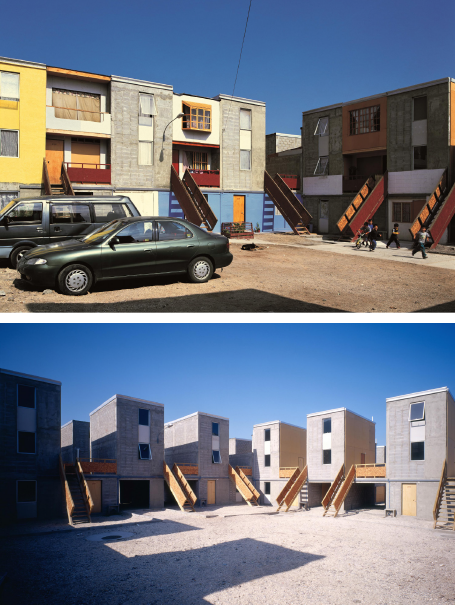
Since 2001, Aravena has been executive director of the Santiago-based ELEMENTAL, a “Do Tank,” as opposed to a think tank, whose partners are Gonzalo Arteaga, Juan Cerda, Victor Oddó, and Diego Torres. ELEMENTAL focuses on projects of public interest and social impact, including housing, public space, infrastructure, and transportation. ELEMENTAL has designed more than 2,500 units of low-cost social housing. A hallmark of the firm is a participatory design process in which the architects work closely with the public and end users. ELEMENTAL is also known for designing social housing that they call “half of a good house,” in which the design leaves space for the residents to complete their houses themselves and thus raise themselves up to a middle-class standard of living. This innovative approach, called “incremental housing,” allows for social housing to be built on more expensive land closer to economic opportunity and gives residents a sense of accomplishment and personal investment.
In response to being named the 2016 Laureate of the Pritzker Architecture Prize, Mr. Aravena emailed: “Looking backwards, we feel deeply thankful. No achievement is individual. Architecture is a collective discipline. So we think, with gratitude, of all the people who contributed to give form to a huge diversity of forces at play. Looking into the future we anticipate Freedom! The prestige, the reach, the gravitas of the prize is such that we hope to use its momentum to explore new territories, face new challenges, and walk into new fields of action. After such a peak, the path is unwritten. So our plan is not to have a plan, face the uncertain, be open to the unexpected. Finally, looking at the present, we are just overwhelmed, ecstatic, happy. It's time to celebrate and share our joy with as many people as possible.”
The 2016 Pritzker Architecture Prize Jury Citation states in part, “Alejandro Aravena has delivered works of architectural excellence in the fields of private, public and educational commissions both in his home country and abroad…. He has undertaken projects of different scales from single-family houses to large institutional buildings…. He understands materials and construction, but also the importance of poetry and the power of architecture to communicate on many levels.”
Aravena and ELEMENTAL have designed the Metropolitan Promenade (1997 - ongoing) and Bicentennial Children’s Park (2012), both in Santiago. After the 2010 earthquake and tsunami that hit Chile, ELEMENTAL was called to work on the reconstruction of the city of Constitución; their work there includes emergency relief work, a master plan, Villa Verde (incremental housing, 2013), and the Constitución Cultural Center (2014). Other works include a Montessori School (2001) in Santiago, Chile; “Chairless” furniture (2010) for Vitra in Weil am Rhein, Germany; Monterrey Housing (incremental housing, 2010) in Monterrey, Mexico; Las Cruces Pilgrim Lookout Point (2010) in Jalisco, Mexico; Calama PLUS master plan (2012 - ongoing) in Calama, Chile; Writer’s Cabin for the Jan Michalski Foundation (2015) in Montricher, Switzerland; and Ayelén School (2015) in Rancagua, Chile.
Alejandro Aravena is the Director of the Venice Architecture Biennale 2016, titled “Reporting from the Front,” set to open in May 2016.
The Chair of the Jury of the Pritzker Architecture Prize, Lord Peter Palumbo, said that, as the jury visited Aravena’s projects, they felt a sense of wonder and revelation; they understood that his is an innovative way of creating great architecture, with the best yet to come. Referencing John Keats’ poem “On First Looking into Chapman’s Homer,” Lord Palumbo said, "Stout Cortez stared at the Pacific with eagle eyes, whilst the Pritzker jury felt like some watcher of the skies when a new planet swims into his ken: And although not silent upon a peak in Darien, they looked at each other with a wild surmise, captivated, stunned, and overwhelmed by the work of Alejandro Aravena and the promise of a golden future.”
Alejandro Aravena of Chile receives the 2016 Pritzker Architecture Prize
He practices architecture as an artful endeavor in private commissions and in designs for the public realm and epitomizes the revival of a more socially engaged architect.
Chicago, IL (January 13, 2016) — Alejandro Aravena of Chile has been selected as the 2016 Pritzker Architecture Prize Laureate, Tom Pritzker announced today. Mr. Pritzker is Chairman and President of The Hyatt Foundation, which sponsors the prize. The formal award ceremony for what has come to be known internationally as architecture’s highest honor will be at United Nations Headquarters in New York on April 4, 2016.
The 48-year-old Aravena is an architect based in Santiago, Chile. He becomes the 41st laureate of the Pritzker Prize, the first Pritzker Laureate from Chile, and the fourth from Latin America, after Luis Barragán (1980), Oscar Niemeyer (1988), and Paulo Mendes da Rocha (2006).
Mr. Pritzker said, “The jury has selected an architect who deepens our understanding of what is truly great design. Alejandro Aravena has pioneered a collaborative practice that produces powerful works of architecture and also addresses key challenges of the 21st century. His built work gives economic opportunity to the less privileged, mitigates the effects of natural disasters, reduces energy consumption, and provides welcoming public space. Innovative and inspiring, he shows how architecture at its best can improve people’s lives.”
Aravena has completed remarkable buildings at the esteemed Universidad Católica de Chile in Santiago, including the UC Innovation Center – Anacleto Angelini (2014), the Siamese Towers (2005), Medical School (2004), School of Architecture (2004), and the Mathematics School (1999). These energy-efficient buildings respond to the local climate with innovative, efficient facades and floor plans and offer the users natural light and convivial meeting places. Currently under construction in Shanghai, China, is an office building for healthcare company Novartis, with office spaces designed to accommodate different modes of work — individual, collective, formal and informal. In the United States, Aravena has built St. Edward’s University Dorms (2008) in Austin, Texas.
Since 2001, Aravena has been executive director of the Santiago-based ELEMENTAL, a “Do Tank,” as opposed to a think tank, whose partners are Gonzalo Arteaga, Juan Cerda, Victor Oddó, and Diego Torres. ELEMENTAL focuses on projects of public interest and social impact, including housing, public space, infrastructure, and transportation. ELEMENTAL has designed more than 2,500 units of low-cost social housing. A hallmark of the firm is a participatory design process in which the architects work closely with the public and end users. ELEMENTAL is also known for designing social housing that they call “half of a good house,” in which the design leaves space for the residents to complete their houses themselves and thus raise themselves up to a middle-class standard of living. This innovative approach, called “incremental housing,” allows for social housing to be built on more expensive land closer to economic opportunity and gives residents a sense of accomplishment and personal investment.
In response to being named the 2016 Laureate of the Pritzker Architecture Prize, Mr. Aravena emailed: “Looking backwards, we feel deeply thankful. No achievement is individual. Architecture is a collective discipline. So we think, with gratitude, of all the people who contributed to give form to a huge diversity of forces at play. Looking into the future we anticipate Freedom! The prestige, the reach, the gravitas of the prize is such that we hope to use its momentum to explore new territories, face new challenges, and walk into new fields of action. After such a peak, the path is unwritten. So our plan is not to have a plan, face the uncertain, be open to the unexpected. Finally, looking at the present, we are just overwhelmed, ecstatic, happy. It's time to celebrate and share our joy with as many people as possible.”
The 2016 Pritzker Architecture Prize Jury Citation states in part, “Alejandro Aravena has delivered works of architectural excellence in the fields of private, public and educational commissions both in his home country and abroad…. He has undertaken projects of different scales from single-family houses to large institutional buildings…. He understands materials and construction, but also the importance of poetry and the power of architecture to communicate on many levels.”
Aravena and ELEMENTAL have designed the Metropolitan Promenade (1997 - ongoing) and Bicentennial Children’s Park (2012), both in Santiago. After the 2010 earthquake and tsunami that hit Chile, ELEMENTAL was called to work on the reconstruction of the city of Constitución; their work there includes emergency relief work, a master plan, Villa Verde (incremental housing, 2013), and the Constitución Cultural Center (2014). Other works include a Montessori School (2001) in Santiago, Chile; “Chairless” furniture (2010) for Vitra in Weil am Rhein, Germany; Monterrey Housing (incremental housing, 2010) in Monterrey, Mexico; Las Cruces Pilgrim Lookout Point (2010) in Jalisco, Mexico; Calama PLUS master plan (2012 - ongoing) in Calama, Chile; Writer’s Cabin for the Jan Michalski Foundation (2015) in Montricher, Switzerland; and Ayelén School (2015) in Rancagua, Chile.
Alejandro Aravena is the Director of the Venice Architecture Biennale 2016, titled “Reporting from the Front,” set to open in May 2016.
The Chair of the Jury of the Pritzker Architecture Prize, Lord Peter Palumbo, said that, as the jury visited Aravena’s projects, they felt a sense of wonder and revelation; they understood that his is an innovative way of creating great architecture, with the best yet to come. Referencing John Keats’ poem “On First Looking into Chapman’s Homer,” Lord Palumbo said, "Stout Cortez stared at the Pacific with eagle eyes, whilst the Pritzker jury felt like some watcher of the skies when a new planet swims into his ken: And although not silent upon a peak in Darien, they looked at each other with a wild surmise, captivated, stunned, and overwhelmed by the work of Alejandro Aravena and the promise of a golden future.”
mercoledì 16 dicembre 2015
Œuvres poétiques de Charles Péguy en « Pléiade »
lunedì 14 dicembre 2015
Il post numero 2000 di DaSeyn
DaSeyn: EsserCi.
Escursioni in Arte, Architettura, Cinema, Design, Grafica, Internet, Informatica, Letteratura, Teatro.
Daseyn è già un tentativo, esplorazione di alcuni verso l'avanguardia, verso la capacità di vedere il nuovo che é al di là, e scoprire che in realtà è l'antico che, instancabilmente, torna.
DaSeyn è già un progetto comune, l'immaginare la novità insieme. DaSeyn non é ancora ciò che deve essere, ma c'è.
Manca l'inevitabile "lavorio del tempo".
Il tempo di duemila post non ha ancora reso DaSeyn ciò che deve essere, eppure la fedeltà a questo "immaginare la novità insieme" c'è stata. E, soprattutto, c'è stato l'essere insieme, fra noi e con tutti quelli che hanno voluto e vorranno accompagnarci, perché "è profezia l'amicizia, significato ed origine comune di noi viventi".
domenica 13 dicembre 2015
Steve Jobs syrien sur les murs de Calais

Steve Jobs, l'ancien patron d'Apple, un baluchon sur le dos et un ordinateur en main, sous un pont de Calais... La dernière oeuvre de Banksy, mystérieux artiste britannique célèbre pour ses fresques murales, fait réfléchir. Le street artist a voulu une nouvelle fois éveiller les esprits au sujet de la crise migratoire en choisissant de représenter Steve Jobs, fils d'un migrant de Syrie, sur un pont à l'entrée de la jungle de Calais.
D'après le Huffington Post, Banksy aurait déclaré : "Apple paie plus de 7 milliards de dollars d'impôts chaque année, et existe seulement car on a accueilli un jeune homme venu de Homs." D'après le site Culturebox, le père de Steve Jobs était en effet syrien, originaire d'Homs.
sabato 12 dicembre 2015
Iscriviti a:
Post (Atom)
Campionare i fumetti: Samplerman comics by Yvang
"Yvan Guillo, aka Yvang, è un fumettista francese nato nel 1971. Ha cominciato pubblicando fumetti in varie fanzine fin dai primi anni ...
-
Fig. 1 : Pablo Zelaya Sierra. Paisaje con hombre segando . 73 x 63.5 cm. Sin fecha . Fig. 2 : Pablo Zelaya Sierra. La...
-
Fig. 1 : Pablo Zelaya Sierra. Campesinas . 1932. Oleo sobre lienzo. 73.7 x 83.4 cm Fig. 2 : Pablo Zelaya Sierra. La...